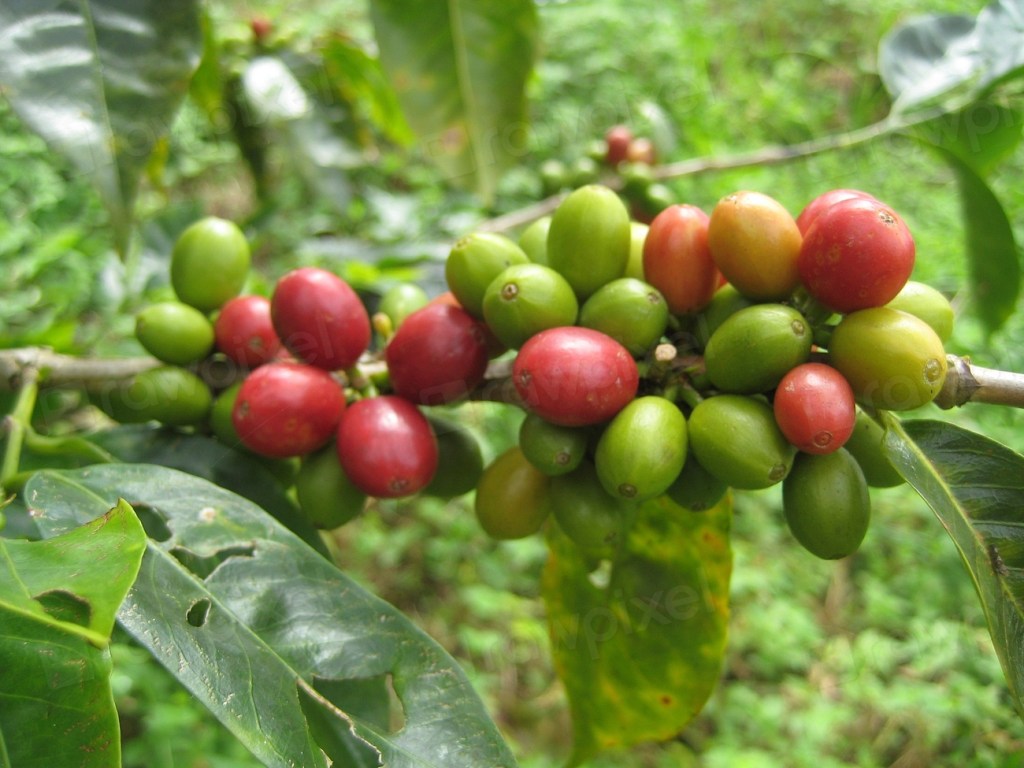
“Do you know where in the world coffee is grown?” our tour guide, Julio, asked as the ten of us huddled around him, the scent of roasted beans lingering in the air.
It was our first time visiting a coffee farm in Costa Rica. Julio led us toward a world map on the wall.
“Central America,” someone offered.
“Africa,” another added.
“Asia,” someone else chimed in.
“You’re all correct,” Julio smiled. “But does anyone know what the growing region is called?”
We glanced around and shook our heads.
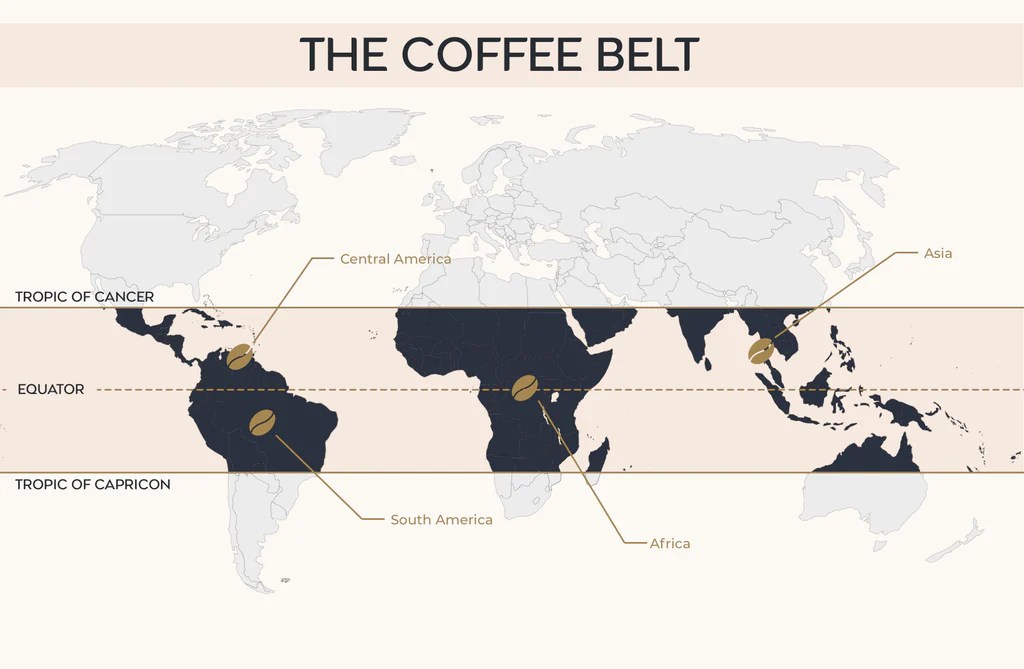
“Coffee is grown inside the coffee belt,” he explained, pointing toward the map.
The coffee belt, we learned, is a geographic zone between the Tropics of Cancer and Capricorn—spanning roughly 25 degrees north and 30 degrees south of the equator—where conditions are just right for coffee to thrive. Rich volcanic soil, warm temperatures, high altitudes, and steady rainfall make it the ideal environment.
As an occasional coffee drinker, I was fascinated. I had never considered that crops like coffee could only grow in specific regions.
Since then, we’ve visited a cacao farm and a tea plantation. The same principle applies: cacao grows in the cacao belt, and tea flourishes in just a handful of countries with the right mix of climate, soil, and rainfall.
We learned this lesson firsthand when we tried gardening at home. The leaves on my dahlia flowers looked especially wilty, and the blooms drooped within two days of planting.
Even though I had checked all the boxes—plenty of water, full sun—the dahlias didn’t perk up until I replaced the regular soil with fast-draining soil, which they actually needed.
In nature, a plant—whether a coffee bean, a tea leaf, or a flower—cannot thrive unless it’s in an environment that supports its growth. It needs the right mix of climate, soil, and sun exposure to reach its full potential.
The more I learned about what plants need to thrive, the more I saw the parallel: we, too, need the right environment to grow—especially at work.
Finding Your ‘Thriving’ Place at Work
Having worked at or consulted for half a dozen companies, I’ve seen firsthand how each organization has its own unique environment—shaped by its culture, leadership style, mission, values, and people.
Each workplace has its own set of “growing conditions.” And those conditions, fortunately or unfortunately, aren’t ideal for everyone.

Take Amazon and Starbucks, for example. At Amazon, efficiency is prized over personal connection. At Starbucks, “human connection” is a core part of the mission. The culture encourages casual coffee chats between colleagues as a way to foster relationships.
My partner thrives in Amazon’s environment. For me, Starbucks provides a better space where I do my best work.
If your workplace feels frustrating or draining, you might just be a coffee bean trying to grow outside the coffee belt—not because you’re not capable, but because the conditions aren’t right for you.
To find the kind of workplace where you’ll thrive, you first have to understand what kind of “plant” you are. Are you a coffee bean or a tea plant? Do you prefer full sun or shade? What kind of environment brings out your best?
I promise you: there’s a company out there with the perfect soil, climate, and care for you. And if you can’t find that place? Don’t settle. Create it for yourself.
Planting Conditions for an Idea to Thrive
I once worked for a visionary CEO who advised Silicon Valley executives on how to build user-centric organizations—places where technologies are intuitively designed because everyone from top to bottom deeply understands the end user.
He developed a formula I still think about today:
Business Value by Design = People × Process × Mindset × Environment
Most organizations invest in people and process. Some nurture the right mindset. But many overlook one of the most important elements: environment.
And yet, environment is often the make-or-break factor that determines whether an idea survives—or withers on the vine.
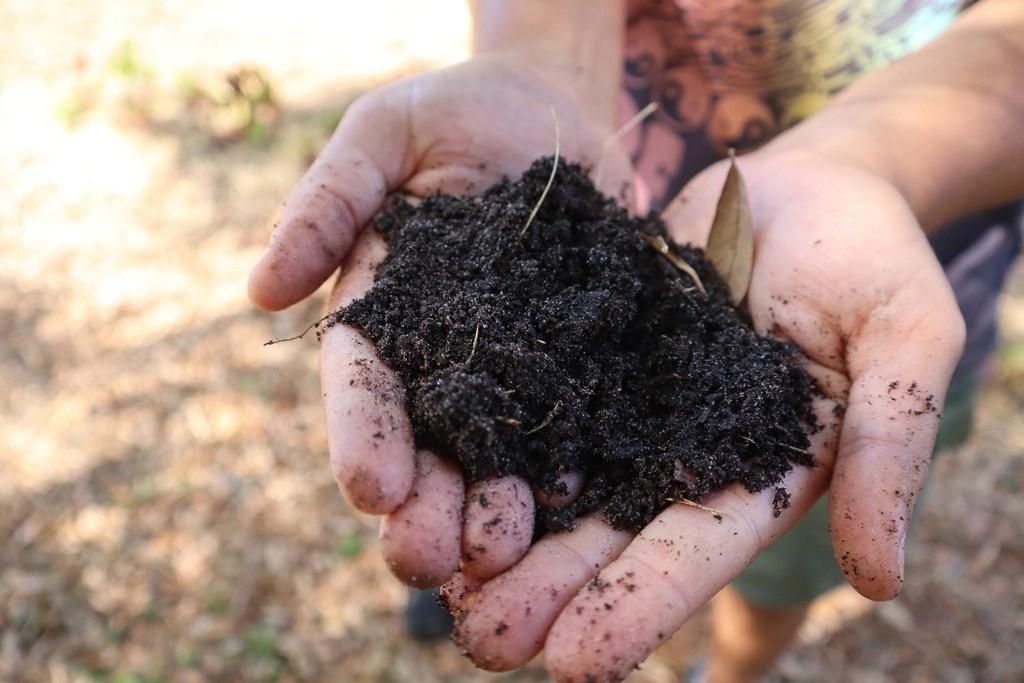
Just like a cacao seed won’t sprout outside the cacao belt, an idea won’t thrive in a company that isn’t ready for it. If the soil isn’t fertile, if the climate is too harsh, if there isn’t space for it to breathe and evolve—it doesn’t matter how visionary the idea is.
I’ve seen brilliant ideas fall flat because the culture wasn’t open to experimentation. I’ve also seen small ideas spark big transformation, simply because the conditions encouraged collaboration, risk-taking, and iteration.
So before you judge an idea as “good” or “bad,” ask instead:
- Is the environment ready for this idea to grow?
- Are the conditions—leadership buy-in, team readiness, psychological safety, timing—there?
- And if not, what can be done to improve the soil.
Because sometimes, it’s not the seed that’s lacking. It’s the soil.
Where are you meant to grow?
Whether it’s a coffee bean, a flower, a person, or an idea—everything needs the right environment to truly thrive.
Growth isn’t just about effort or potential; it’s about fit. You could be doing everything “right,” but if the conditions around you aren’t aligned, you’ll always feel like you’re struggling to bloom.
So ask yourself: What’s your ideal growing environment?
What kind of soil, climate, and care help you flourish? And what about the ideas you carry—are they planted in the right place to take root?
The more we understand what helps us—and our ideas—grow, the better equipped we are to seek out or create environments where thriving becomes not the exception, but the norm.
Inviting You to Reflect on:
- What kind of “plant” are you? What conditions help you thrive?
- Are you currently in your coffee belt—or trying to grow outside of it?
- What kind of environment do your ideas need to take root?

 Elevate Everyday