Category: Personal Growth

  • More Appreciation, Less Expectation

    More Appreciation, Less Expectation

    I woke up to seven unread WeChat messages—all from my mom, who lives halfway across the world in China.

    Opening the app, I saw pictures of a jacket and two blouses.

    “I think this shirt will look good with a pair of jeans,” one of her messages read.

    It was 11:15 p.m. in China. Having grown up with her, I know how much she needs her sleep. My grandma even lovingly called her “睡觉包” (“sleepyhead”). She normally goes to bed by 9:30 p.m., so I could only imagine how tired she must’ve been.

    “I see them. You should go to bed. Let’s chat live tonight. I like the jacket and the first blouse. Do they have any other colors for the jacket? Can you help me look at some jeans?” I wrote back.

    Five minutes later—Ding… Ding… Ding… Ding. My phone rang again.

    She sent photos of a long skirt.

    “What about this one?” she asked.

    “Okay, sure.” I replied.

    Ding. A photo of the same jacket in another color.

    Then another.

    “Looks good,” I responded. “You should go to sleep.”

    A minute later—

    “What kind of collar do you want?” she asked via WeChat.

    “Go to sleep,” I replied again.

    You see, my grandma and sister are coming to visit this summer. The last time they visited, they brought me half a suitcase full of clothes that my mom had picked out for me.

    My mom has always carried a bit of guilt for not being able to take care of or spend money on me since I moved to the U.S. to live with my father when I was twelve years old. My sister, on the other hand, stayed in China with my mom and received all the love, care, and attention.

    Over the past twenty years, I’ve only seen my mom in person half a dozen times. So she’s found other ways to show her love—from afar. One of them is buying me clothes.

    I’ve known this about her. So in some ways, I wasn’t surprised by the stream of photos. In fact, I almost expected my sister and grandma to arrive this summer with another suitcase filled with things my mom picked out.

    Ding. My mom sent another blouse—this time in green.

    “Go to sleep, mom,” I wrote again, pleading for the fourth time.

    And that’s when it hit me. I felt a lump in my throat and found myself tearing up.

    Maybe it’s part of growing older. Maybe it’s the idea of becoming a parent myself. Maybe I’ve simply become more attuned to love’s quieter expressions.

    In that moment, I felt completely connected to my mom—emotionally, spiritually—even from across the world. I could almost see her sitting on the edge of her bed, hunched over in the dark, with the light from her phone glowing softly on her face as she scrolled through photos, searching for the perfect item to match my taste and style.

    In that quiet night, I saw and felt the deep, unconditional love of a mother.

    And then I felt a wave of embarrassment.

    I realized how often I’ve taken her love—and her—for granted. How I’ve come to expect these gifts instead of appreciating the care and emotion behind them. As if they were something she owed me.

    But they’re not owed. They’re offered. Freely. Lovingly.

    And they deserve gratitude.

    More appreciation. Less expectation.


    We often take our most sacred relationships for granted.

    They’re the people closest to us—our parents, siblings, partners, grandparents. Yet these are often the ones we fail to honor in the way they deserve.

    There’s usually more expectation than appreciation.
    Less patience. Less kindness.
    And sometimes, even less forgiveness than we’d offer a stranger on the street.

    This was a reminder for me to:

    • Practice more appreciation, rather than expectation
    • Say more thank yous
    • Give our loved ones the attention they deserve
    • Be more patient and forgiving
    • And, to never take our most sacred relationships for granted—but instead, to honor each one with the love and care they so deeply deserve

    Inviting You to Reflect On:

    • Who in your life have you been taking for granted?
    • How can you express appreciation to someone close to you today?

  • Where Are You Meant to Grow?

    Where Are You Meant to Grow?

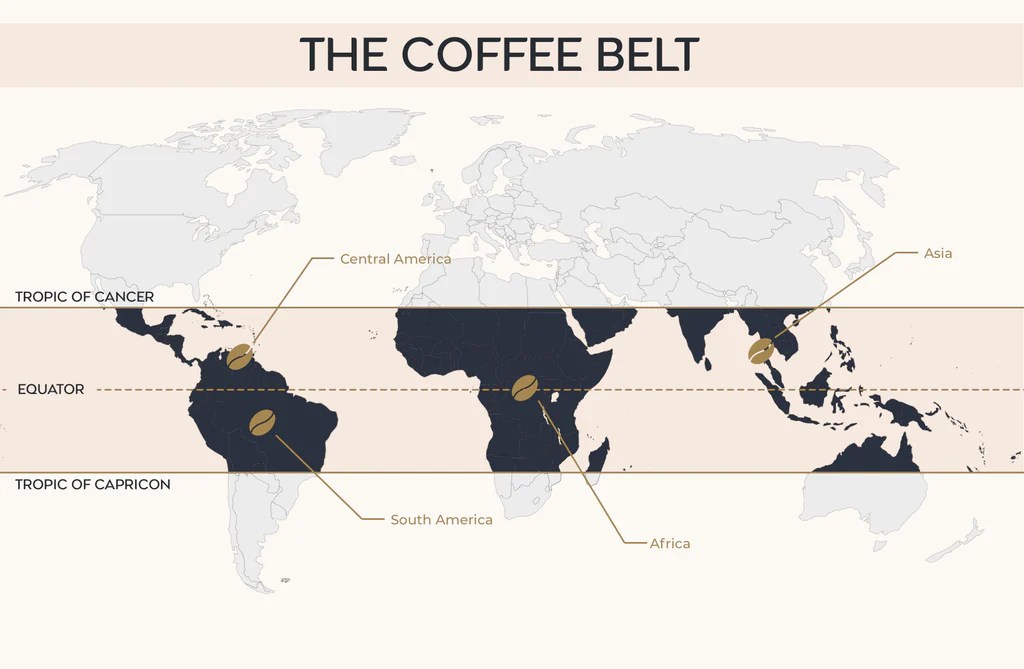
    “Do you know where in the world coffee is grown?” our tour guide, Julio, asked as the ten of us huddled around him, the scent of roasted beans lingering in the air.

    It was our first time visiting a coffee farm in Costa Rica. Julio led us toward a world map on the wall.

    “Central America,” someone offered.
    “Africa,” another added.
    “Asia,” someone else chimed in.

    “You’re all correct,” Julio smiled. “But does anyone know what the growing region is called?”

    We glanced around and shook our heads.

    “Coffee is grown inside the coffee belt,” he explained, pointing toward the map.

    The coffee belt, we learned, is a geographic zone between the Tropics of Cancer and Capricorn—spanning roughly 25 degrees north and 30 degrees south of the equator—where conditions are just right for coffee to thrive. Rich volcanic soil, warm temperatures, high altitudes, and steady rainfall make it the ideal environment.

    As an occasional coffee drinker, I was fascinated. I had never considered that crops like coffee could only grow in specific regions.

    Since then, we’ve visited a cacao farm and a tea plantation. The same principle applies: cacao grows in the cacao belt, and tea flourishes in just a handful of countries with the right mix of climate, soil, and rainfall.

    We learned this lesson firsthand when we tried gardening at home. The leaves on my dahlia flowers looked especially wilty, and the blooms drooped within two days of planting.

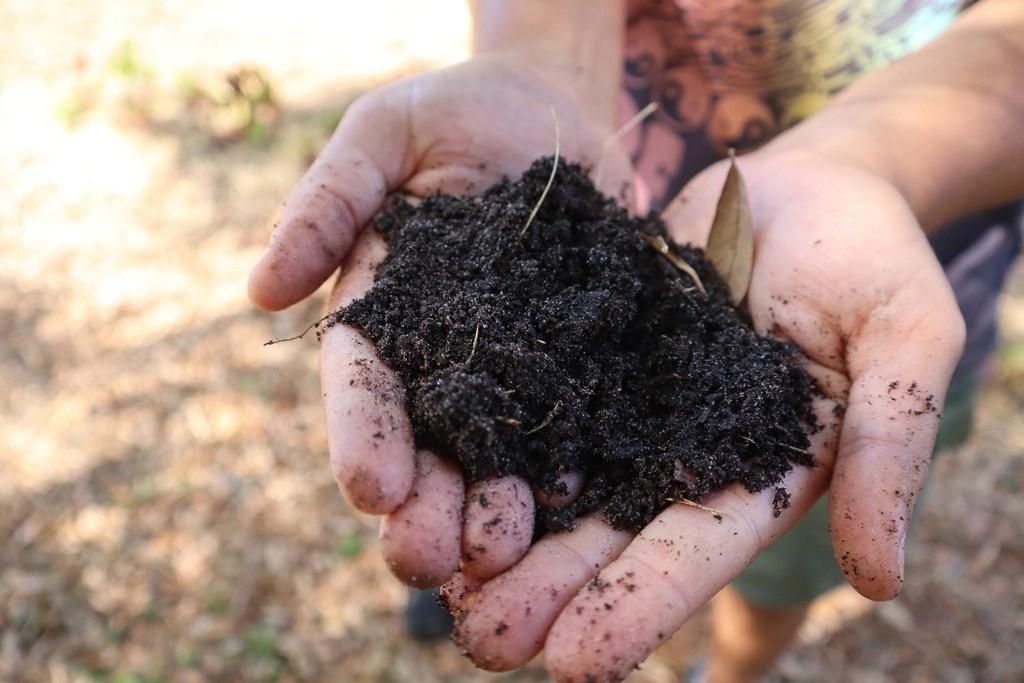
    Even though I had checked all the boxes—plenty of water, full sun—the dahlias didn’t perk up until I replaced the regular soil with fast-draining soil, which they actually needed.

    In nature, a plant—whether a coffee bean, a tea leaf, or a flower—cannot thrive unless it’s in an environment that supports its growth. It needs the right mix of climate, soil, and sun exposure to reach its full potential.

    The more I learned about what plants need to thrive, the more I saw the parallel: we, too, need the right environment to grow—especially at work.

    Finding Your ‘Thriving’ Place at Work

    Having worked at or consulted for half a dozen companies, I’ve seen firsthand how each organization has its own unique environment—shaped by its culture, leadership style, mission, values, and people.

    Each workplace has its own set of “growing conditions.” And those conditions, fortunately or unfortunately, aren’t ideal for everyone.

    Take Amazon and Starbucks, for example. At Amazon, efficiency is prized over personal connection. At Starbucks, “human connection” is a core part of the mission. The culture encourages casual coffee chats between colleagues as a way to foster relationships.

    My partner thrives in Amazon’s environment. For me, Starbucks provides a better space where I do my best work.

    If your workplace feels frustrating or draining, you might just be a coffee bean trying to grow outside the coffee belt—not because you’re not capable, but because the conditions aren’t right for you.

    To find the kind of workplace where you’ll thrive, you first have to understand what kind of “plant” you are. Are you a coffee bean or a tea plant? Do you prefer full sun or shade? What kind of environment brings out your best?

    I promise you: there’s a company out there with the perfect soil, climate, and care for you. And if you can’t find that place? Don’t settle. Create it for yourself.

    Planting Conditions for an Idea to Thrive

    I once worked for a visionary CEO who advised Silicon Valley executives on how to build user-centric organizations—places where technologies are intuitively designed because everyone from top to bottom deeply understands the end user. 

    He developed a formula I still think about today:
    Business Value by Design = People × Process × Mindset × Environment

    Most organizations invest in people and process. Some nurture the right mindset. But many overlook one of the most important elements: environment.

    And yet, environment is often the make-or-break factor that determines whether an idea survives—or withers on the vine.

    Just like a cacao seed won’t sprout outside the cacao belt, an idea won’t thrive in a company that isn’t ready for it. If the soil isn’t fertile, if the climate is too harsh, if there isn’t space for it to breathe and evolve—it doesn’t matter how visionary the idea is.

    I’ve seen brilliant ideas fall flat because the culture wasn’t open to experimentation. I’ve also seen small ideas spark big transformation, simply because the conditions encouraged collaboration, risk-taking, and iteration.

    So before you judge an idea as “good” or “bad,” ask instead:

    • Is the environment ready for this idea to grow?
    • Are the conditions—leadership buy-in, team readiness, psychological safety, timing—there?
    • And if not, what can be done to improve the soil.

    Because sometimes, it’s not the seed that’s lacking. It’s the soil.

    Where are you meant to grow?

    Whether it’s a coffee bean, a flower, a person, or an idea—everything needs the right environment to truly thrive.

    Growth isn’t just about effort or potential; it’s about fit. You could be doing everything “right,” but if the conditions around you aren’t aligned, you’ll always feel like you’re struggling to bloom.

    So ask yourself: What’s your ideal growing environment?

    What kind of soil, climate, and care help you flourish? And what about the ideas you carry—are they planted in the right place to take root?

    The more we understand what helps us—and our ideas—grow, the better equipped we are to seek out or create environments where thriving becomes not the exception, but the norm.


    Inviting You to Reflect on:

    • What kind of “plant” are you? What conditions help you thrive?
    • Are you currently in your coffee belt—or trying to grow outside of it?
    • What kind of environment do your ideas need to take root?
  • The Unexpected Joy of Talking to Strangers

    The Unexpected Joy of Talking to Strangers

    It was a rainy Saturday morning. Since moving to my new home six months ago, I hadn’t really gotten involved in the community—until yesterday, when I volunteered at the local art museum for the first time.

    My role was simple: help check in guests as they arrived for a spring event.

    As an introvert who would usually rather look at her phone than engage in small talk with strangers, this meant stepping outside of my comfort zone. For a full hour, I greeted people, exchanged pleasantries, and made conversation with guests I had never met before.

    What I never would have guessed was how I’d feel leaving the museum after my shift—I walked out feeling like I had just won the lottery.

    To my surprise, I felt an immense sense of joy and aliveness from doing something I had long assumed was energy-draining rather than life-giving: talking to strangers.

    Simple exchanges like “I love the color of your coat,” “What brings you in today?” or “How’s your morning so far?” opened the door to something deeper.

    For me, it was the feeling of being connected to another human being, and knowing I’d brightened someone’s day—even if just for a moment—that made it all feel so special.

    It was witnessing a shift in body language—from closed and guarded to open and relaxed.

    It was watching someone’s mood transform—from distant to animated and full of life.

    It was catching the sparkle in their eyes and seeing a smile spread across their face.

    It was hearing them initiate a follow-up conversation, giving me a glimpse into their world:

    “I made sure I was first in line today because I have my eyes on this watercolor card with a fox on it…”

    It was discovering their essence radiating from the inside out.

    It was witnessing change in others—and feeling an unexpected joy ripple within me—through the simple act of striking up a conversation and sharing a laugh together.

    That hour reminded me of something I had forgotten: the quiet, healing power of human connection. These small moments are like electric pulses that reactivate our hearts, reminding us of our innate capacity for love, for empathy, and for joy.

    We are all connected—interwoven in ways we may have forgotten, with powers we too often neglect. The power to brighten someone else’s day. The power to show up with kindness. The power to connect.

    In a world that feels increasingly digitized, mechanized, and divided, we need connection now more than ever—more than we may even realize.

    For me, this means continuing to show up in my community. Saying yes to new experiences. And rediscovering the joy of talking to strangers.

    It doesn’t have to be a big gesture either. It could be as small as saying something kind to the cashier at the grocery store or asking “How’s your morning been?” when we call customer service next.

    A little can go a long way.

    And that power—that light—is already within us.


    Inviting You to Reflect on:

    • When was the last time you had a meaningful interaction with a stranger? How did it make you feel?
    • In what simple ways can you bring more warmth and connection into your everyday encounters?
    • What would it look like to be a source of light in someone else’s day today?
  • Speaking with Confidence: What No One Ever Told You

    Speaking with Confidence: What No One Ever Told You

    As the VP of Membership at my company’s Toastmasters club, I hold onboarding calls with prospective members to share more about the club and learn why they’re interested in joining.

    “I’m good at communicating one-on-one, but…”

    After speaking with 50+ prospective members, I started noticing a pattern—it’s what comes after the but.

    “But not in a larger forum.”

    “But I get nervous speaking up in front of an audience of 10+ people.”

    “But when I’m communicating with a VP, I fumble. I don’t make sense, and I start to ramble.”

    “But I black out when I present in front of a room full of people.”

    Our members want to communicate confidently, concisely, and impactfully—in front of anyone, in any setting. That makes sense. After all, Toastmasters is a platform designed to improve public speaking skills.

    What surprises me most, though, is who is sharing these goals. Frankly, 80% of the people who say this already seem like strong communicators—structuring their thoughts well, using minimal filler words, and delivering messages concisely.

    Is It Really About Communication Skills?

    That got me thinking: What’s the difference between communicating one-on-one versus in front of a larger audience or senior leaders? After all, the raw mechanics of communication are the same in both settings.

    And what if… it’s not communication skills our members need, but something deeper?

    I thought back to my first project review with our VP, Jeff.

    I knew my material inside and out. But when Jeff asked me a simple question, I completely blanked. My heart pounded, my breath became shallow, and everything I knew vanished.

    The nerves got me.

    Afterward, I felt terrible. I related to what Jen, a prospective member, told me who shared a similar experience:

    “My VP probably thinks I’m dumb. That I don’t know what I’m doing. They probably won’t want me in the meeting anymore.”

    I felt some of that, too.

    But here’s the truth: No one thinks that way except us.

    Most people—whether it’s your VP, CEO, or peer—want to see you succeed.

    Which makes me wonder: Is mastering public speaking less about technical skills and more about overcoming the illusions we create in our own minds?

    Which makes me wonder:

    Is mastering public speaking less about technical skills and more about overcoming the illusions we create in our own minds?

    The Real Barriers to Communicating with Confidence

    It’s not just about how we speak – it’s about what we believe.

    …the stories we tell ourselves.

    …The pressure to prove ourselves – to sound smart, to earn our seat at the table. (And on the flip side, the fear of not sounding or looking smart)

    …The doubt and judgement we place on ourselves, replaying the could haves and should haves after the fact.

    Simply put, we paralyze OURSELVES with our own fears, doubts, goals, and criticisms.

    The real key to public speaking? Mastering ourselves.

    So, what if the secret isn’t just in refining our communication skills, but in mastering ourselves–removing self-doubt, releasing unwarranted pressure, and giving ourselves grace?

    (Because again, most people want to see you succeed.)

    • To stop judging ourselves so harshly
    • To let go of the need to have all the answers
    • To believe we deserve to be in the room
    • To give ourselves permission to communicate with confidence
    • To offer ourselves grace if we stumble
    • Most of all, to trust and give ourselves permission to be our authentic selves–without fear or judgment

    What if we were to release all of our fears and replace them with love and self-acceptance?

    How would we show up?

    How would we communicate then?

  • Yes, And: Rethinking the Limits We Place on Ourselves

    Yes, And: Rethinking the Limits We Place on Ourselves

    During my MBA program, I was part of the Improv Club, where we’d meet every week to play improv games.

    One of the core principles of improv is “Yes, And.” It’s a simple but powerful rule: accept what another improviser has stated (“yes”) and then build upon it (“and”). It encourages openness, creativity, and the willingness to explore beyond the obvious.

    This principle came to mind recently when I caught up with a friend who mentioned that my former MBA classmate and housemate, Sammi, had gained influencer status—with over 260K subscribers on Instagram.

    What? How? When?

    I had so many questions.

    When I looked into it, I learned that since 2022, Sammi has been posting daily short videos demystifying the latest business ‘lore.’ I knew she worked at Amazon after we graduated from business school in 2020.

    Is she still working full-time? Amazon can be a pretty intense place…

    A quick glance at her LinkedIn profile and a recent interview, How to Build an Audience of 250K and Keep Your Day Job, confirmed it—she had built her massive following while juggling a full-time job.

    Having known Sammi, I wasn’t surprised by her drive. She’s a go-getter. But still, I was impressed.

    Getting to learn more about her success and specifically how she’s been able to do both inspired me to reexamine my own life and my belief systems around the prerequisite to success.

    The Trap of “Either-Or” Thinking

    I realized that I’ve often operated with an “Either-Or” mindset:

    • Either I work a corporate job or I start my own business.
    • Either I pursue a successful career or I prioritize family.
    • Either I take a creative risk or I play it safe.

    This way of thinking isn’t unique to me. We see it everywhere:

    • Either finish your homework now, or you can’t go out with your friends later.
    • Either go on vacation, or save for a house.

    It’s easy to see why “Either-Or” thinking is our default. It simplifies decision-making. It’s clear-cut. You pick one, and you move on. But what if that’s an illusion?

    The Power of “Yes, And” Thinking

    Sammi didn’t choose between having a job or building an audience—she did both. She embraced the “Yes, And” mindset.

    Her journey made me ask myself: Where in my life have I been limiting myself with false choices?

    What if instead of assuming we have to choose between two paths, we ask:

    • How can I have a stable job and explore my entrepreneurial ambitions?
    • How can I be career-driven and cultivate deep personal relationships?
    • How can I take creative risks and maintain security?

    The boundaries of “Yes, And” may feel incredibly ambiguous, and that can be uncomfortable. But what possibilities are we shutting out when we limit ourselves to just two options?

    What If We Embrace The Possibilities?

    Psychologists call this the Either-Or Fallacy (False Dilemma)—when we assume there are only two choices and fail to recognize a third (or fourth, or fifth) alternative.

    But what if we challenged that way of thinking?

    What if, rather than limiting ourselves, we started saying “Yes, And” to life?

    What would our world look like then?

  • Befriend the Unknown: A Shift in Mindset

    Befriend the Unknown: A Shift in Mindset

    Photo by Martin Martz on Unsplash

    At 10 a.m., a last-minute “Team Communication” invite from our SVP popped up on our calendars—just three hours before the meeting.

    No context. Just a Microsoft Teams link.

    At 1 p.m., 300+ faces appeared on the call, engaging in lighthearted small talk. But really, we were all bracing ourselves for what was to come.

    It’s fair to say that most of us, myself included, were preoccupied with one question: What’s going to happen to me?

    Understandably, many fear being laid off—this job allows us to provide for our families, pay mortgages, and afford everyday essentials. The thought of giving up our current reality is hard because it feels safe, known, secure.

    On the contrary, the unknown—what comes next—feels terrifying.

    “Katie has decided to leave the organization,” our EVP, Sara, announced. Just last week, she had shared that she, too, was leaving the company.

    They both spoke candidly about their decisions, while reiterating their enthusiasm for the company’s new focus under our new CEO.

    What struck me most wasn’t their departure—it was their attitude toward change.

    “Change excites me,” Katie said, acknowledging the bittersweet moment.

    “Growth requires change,” Sara emphasized, bookending the conversation with this reminder.

    Neither of them flinched in the face of uncertainty. Instead, they welcomed it. There was no hint of fear, no sense of hesitation—only confidence, poise, and authenticity.

    It was an aha moment for me.

    They didn’t deny that change is uncomfortable or that the unknown can be daunting. But they recognized that within discomfort lies an opportunity—for growth, for reinvention, for something greater than what we can currently see.

    I’ve replayed the call in my head several times, and I realize now: I need to adopt a new mindset toward change—one that shifts from fear to a warm embrace.

    Befriend the unknown, because growth requires change.

    What about you?

    What’s your current attitude toward change? What new possibilities might unfold if you befriended the unknown instead of fearing it?

    Subscribe

    Subscribe to a weekly dose of feel-good stories from everyday life in your inbox.

  • Facts over Fear—The Power of Seeing Things as They Are

    Facts over Fear—The Power of Seeing Things as They Are

    And there will be job eliminations…” read a company-wide email from our CEO last Friday.

    I was immediately triggered. The memory of layoffs I experienced just two years ago came rushing back, the feelings still fresh in my mind. Experience as the teacher whispered, “You have to look out for yourself.” So, I started doom-scrolling on LinkedIn to see what jobs were available.

    But then I paused.

    I realized that while experience can teach valuable lessons—like warning a child not to touch a hot stove—it can also be harmful. Sometimes, it keeps us trapped in anticipation of pain, even when the present moment doesn’t warrant it.

    Moments like these rob us of the ability to fully experience the present for what it is—good, bad, or neutral. They blur the line between reality and our imagination.

    A recent conversation with a coworker illustrated this perfectly.

    After our VP’s “Ask-Me-Anything” meeting, I caught up with a coworker from my team. He was convinced we were doomed. “It’s obvious our org will be a lot smaller,” he said.

    I blinked in surprise. I had walked out of the same meeting feeling cautiously optimistic. Our VP had said, “Each of you are doing the right work for the organization.”

    Both of us had attended the same meeting. Yet our takeaways were polar opposites.

    This stark difference in perception reminded me how much our individual interpretations can be shaped by emotions and past experiences. It also underscored a truth I often need to revisit: When uncertainty strikes, our subjective judgment is not always reliable. That’s why it’s so important to anchor ourselves to objective facts.

    Here’s what I know for certain:

    • There will be layoffs in the coming weeks.
    • Layoffs will impact corporate employees.
    • Teams that “coordinate work” or “do the same work” will be affected.

    That’s it. No more, no less. Everything else is conjecture.

    This episode brought to mind a fundamental discipline of Stoicism (a school of philosophy that originated in Ancient Greece and Rome), which has guided many through uncertainty and adversity:

    Discipline of Perception: See things for what they are and do our best to remain objective in any circumstances

    Our ability to perceive situations clearly and with discipline often determines the trajectory of our success and happiness. As the Stoic philosopher Ryan Holiday puts it:

    “You will come across obstacles in life—fair and unfair. And you will discover, time and time again, that what matters most is not what these obstacles are, but how we see them, how we react to them, and whether we keep our composure. This reaction determines how successful we will be in overcoming—or possibly thriving because of—these obstacles.”

    As for me, the story of these layoffs will unfold in the coming weeks.

    But in the meantime, I declare:

    • I will choose to focus on the facts. No more, no less.
    • I will choose to control what I can—my thoughts, actions, and reactions.
    • I will choose to see opportunity in every situation.

    Pages: 1 2